

Hey! 👋
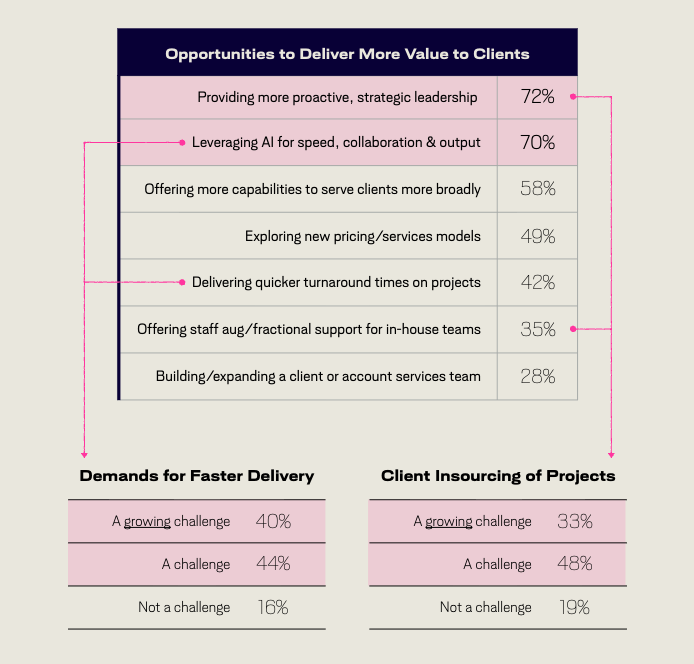
We’re jumping back in for 2026 with a topic that has been top of mind for us at Ten Speed for several months. Coincidentally, as this post was being edited, we came across The SoDA Report On: New strategies for the modern agency from SoDA and Webflow, which provides some great data on this exact topic.
Let us know what you think about this topic!
Cheers,
Nate
⚡️Become a Referral Partner!
Apply to join Ten Speed’s referral partner program on PartnerStack. It is free to apply, and you can earn unlimited commissions on qualified leads and 8% of all ongoing revenue from referred clients for their first 12 months.
The Marketing Agency Model is Broken. Here’s What Needs to Change.
The marketing agency model and what companies need from an agency partner have changed dramatically in the last 12 months.
If you have worked with agencies in the last decade, you know the drill. You hire an agency for execution. They become an extension of your team for the stuff you do not have time or expertise for. You get some strategy upfront, maybe a quarterly check-in, but mostly you are paying for output.
That model works for fewer and fewer companies every year.
The Old Model Was Built for a Different Era
For a long time, agencies functioned as production houses. Places to outsource execution so in-house teams could focus on what was considered “more important.”
The logic made sense. In-house teams were small and stretched thin. Agencies had specialists and processes to crank out content, run campaigns, and manage channels at scale. Strategy stays in-house, execution gets outsourced.
But that division assumed execution was the bottleneck, that in-house teams had bandwidth for strategic work, and that the outsourced work was straightforward.
AI Changed the Economics of Execution
AI tooling and more sophisticated tech stacks have flipped the agency dynamic on its head. Tasks that used to require hours of human effort can now be done in minutes with the right tools and workflows. This is more than a marginal efficiency gain. It’s a fundamental change in how much work a small team can produce.
Competitive content analysis that took a strategist two days now takes a few hours. Repurposing a webinar into a blog post, social clips, and email copy used to be a full day of production work. Now it’s a morning. Monthly reporting that required pulling data from five platforms and building slides can be templated and generated in a fraction of the time.
If your value proposition as an agency was “we have a lot of people who can do a lot of work,” you are in trouble. The work that used to require ten people can now be done by three people with the right systems. And in-house teams are figuring this out too. They have access to the same tools and are building internal workflows that reduce their dependency on agencies for production.
Since headcount is no longer a moat, the question we’ve been asking is: “What are we offering that a client can’t replicate with a few subscriptions and a capable generalist?”
Execution Still Matters. But the Value Proposition Has Changed.
To be clear, companies still need help with execution. Why they need it is what’s changed.
The new model is more about access to optimized workflows and expertise. This means building systems that combine AI and human judgment in ways in-house teams don’t have the time, resources, or expertise to create on their own. Figuring out where AI accelerates the work, where humans need to step in, what the human should be doing, and how to connect those dots into repeatable processes that deliver quality at speed.
An optimized workflow might use AI for initial research synthesis and outline generation, then a subject-matter expert for insight validation and unique angles, AI again for first-draft acceleration, and then a senior editor for quality control and brand voice. Each step has clear inputs, outputs, and quality gates. The result is faster turnaround without sacrificing depth, accuracy, or nuance.
In-house teams don’t have time to build these workflows, or prioritize them. They are busy running campaigns and hitting quarterly targets. They cannot spend months testing AI tools, building integrations, and optimizing handoffs between automated and human work.
This is where agencies should come in, not as a bucket of hours, but as a way for companies to leverage systems and workflows they can’t build themselves.
But execution without strategy is still a waste of money.
Two years ago, you could make assumptions, build a strategy, and execute over the course of a few quarters or a year. Now, the environment moves faster than planning cycles can keep up with.
Take organic content as an example. A strategy built around high-volume keywords and monthly blog publishing was a reasonable approach in 2022. Today, that same company should be thinking about which queries are eaten up by AIOs, zero-click searches that reduce traffic even when rankings hold, and LLMs pulling answers from competitor content. The execution might look similar on the surface, but the strategic rationale behind what to create and why is completely different.
This is why companies need agency partners who can help them figure out what to prioritize, connect efforts to business outcomes, and adapt when things change. For us, this means senior strategists need to be deeply involved in client work. Client-to-strategist ratios need to be lower. And clients need direct access to the people actually building strategy.
The New Agency Sweet Spot
There’s a specific space that agencies need to occupy going forward.
More strategic than traditional agencies. The strategy-light, execution-heavy model doesn’t cut it. Companies need partners who can help them figure out what to do, not just how to do it. That means an agency that can look at your analytics, competitive landscape, and business goals and tell you that your content refresh program matters more than new production right now. Or that your SEO investment should shift from blog content to product page optimization because that’s where the conversion opportunity is.
More flexible than productized services. Fully productized agencies offer fixed deliverables at a fixed price. That works for some companies, but not most. The engagement model needs to flex based on where the company is and what they actually need.
A sales-led org launching a new product might need a short burst of bottom-funnel content to support outbound, not another pillar guide. A team seeing meaningful conversions from AI referral traffic might need to deprioritize traditional search in favor of LLM visibility across existing pages. Post-acquisition, technical consolidation might matter more than net-new content. These aren’t edge cases - they’re all real examples from our clients. Goals change, and agencies need to be able to re-scope work based on what’s actually happening in the business.
Built for how the work actually happens now. This means embracing a mix of full-time team members, specialized contractors, AI-powered workflows, and purpose-built tooling. The goal is deliver high-quality outcomes efficiently, instead of adding another contractor to an account.
We’re not cutting corners with AI to reduce overhead and headcount. Our goal is to be intentional about where human expertise matters the absolute most then build systems to support and amplify it.
The Bottom Line
If you’re evaluating agencies, stop asking how many people they’ll put on your account. Ask how they’re structured to deliver outcomes, how senior the people are who will actually touch your work, and how they adapt when priorities shift.
If you’re running an agency, the math has changed. You can’t win on volume anymore. The defensible position is a combination of strategic depth, operational efficiency, and flexibility that clients genuinely cannot replicate on their own.
Learn more about Ten Speed at www.tenspeed.io.